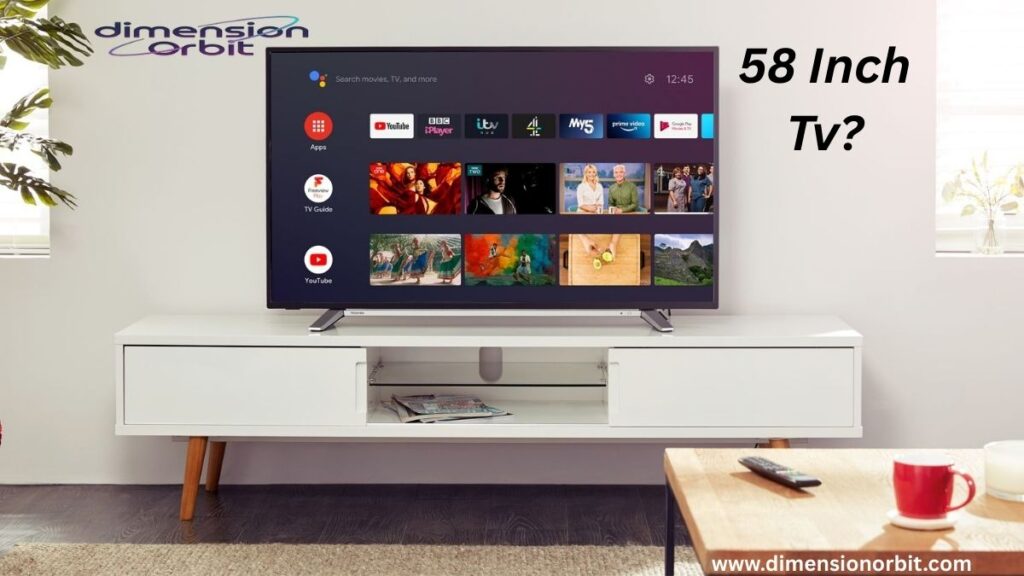
Buying a TV should feel like fun, yet somehow it turns into a geometry exam. You measure the wall. You measure the console. You stare at the box and wonder who decided diagonal inches were helpful. That’s where understanding 58 inch TV dimensions saves the day. This screen size sits in that tempting middle ground, big enough to impress guests but small enough to still fit real homes. However, width, height, depth, and clearance matter far more than the number on the label. This guide breaks down what a 58 inch TV actually looks like in your room, without fluff, jargon, or measuring tape regret.
What “58 Inches” Actually Means on a TV
Let’s clear the biggest misunderstanding right away. When a TV is labeled as 58 inches, that number refers only to the diagonal length of the visible screen. It runs from one corner of the screen to the opposite corner. It does not describe how wide the TV is. It does not describe how tall it is. And it definitely does not describe how much space the TV will take up in your room.
This diagonal measurement comes from old cinema standards and remains useful for comparing screen sizes, but it’s almost useless for furniture planning. That’s why people confidently buy a TV online, only to realize it overhangs their console or blocks a window once it arrives.
Think of the diagonal size as the headline and the width and height as the fine print that actually matters.
The Real Size of a 58 Inch TV
Most modern TVs use a 16:9 aspect ratio. Because of that, the physical dimensions of a 58 inch screen stay fairly consistent across brands, with only small differences caused by bezel thickness and design choices.
In real terms, a typical 58 inch TV measures about 50.5 inches wide and roughly 29.3 inches tall without the stand attached. Once the stand is added, the height usually increases to around 31.5 inches. Depth changes more dramatically depending on whether the TV is wall mounted or sitting on furniture. Without a stand, depth often stays close to 2.5 inches. With a stand, it jumps to around 10 or 11 inches.
These numbers represent the actual width of a 58 inch TV, not the marketing version. They are the measurements that decide whether the TV fits your space or becomes a daily annoyance.
Why Two 58 Inch TVs Don’t Look Exactly the Same Size
This is one of those details that surprises buyers. Two TVs can both be labeled as 58 inches and still look slightly different in size when placed side by side. The reason lies in bezel thickness and frame design.
Some manufacturers use ultra-thin bezels that add very little to the screen size. Others prioritize sturdier frames or built in speakers that increase the overall width or height by small but noticeable amounts. These differences usually measure in fractions of an inch, but when space is tight, those fractions matter.
This is why it’s always safer to plan for an extra inch or two of clearance beyond the listed width and height. That buffer protects you from design variations and makes installation easier.
58 Inch TV Dimensions in Inches and Centimeters

For buyers who want precise numbers, here’s how a typical 58 inch TV breaks down in both imperial and metric units.
The screen diagonal measures 58 inches, which converts to about 147.3 centimeters. The width comes in around 50.5 inches or roughly 128.3 centimeters. The height without the stand sits near 29.3 inches or 74.4 centimeters, while the height with the stand reaches approximately 31.5 inches or 80 centimeters. Depth without the stand averages about 2.5 inches or 6.3 centimeters, and depth with the stand usually lands near 10.5 inches or 26.7 centimeters.
These 58 inch TV dimensions in inches and centimeters cover what most buyers need for planning furniture, wall mounts, and room layout.
Understanding 58 Inch TV Width and Height in Daily Use

Numbers look clean on paper, but daily use tells a clearer story. A width of around 50.5 inches means the TV stretches over four feet across your wall or console. That visual presence feels substantial, especially in smaller rooms. Height matters just as much. A screen that’s nearly 30 inches tall dominates eye level if mounted too high or placed on a tall piece of furniture.
This is where placement choices come into play. A TV mounted too high forces your neck upward, while a TV placed too low feels awkward and cramped. Understanding the real width and height helps you center the screen properly and enjoy it comfortably for hours.
Depth and Clearance: The Part Everyone Forgets

Modern TVs look slim from the side, but depth still matters, especially when cables and ventilation come into play. A 58 inch TV without a stand usually sticks out about 2.5 inches from the wall. Add HDMI cables, power cords, and airflow space, and you should plan for closer to 4 or 5 inches total clearance.
When the TV sits on a stand, depth becomes even more important. Most stands push the TV forward to about 10 or 11 inches. If your console is shallow, the stand may hang off the edge or feel unstable.
Proper clearance also protects the TV’s internal components. Heat needs somewhere to go. Without airflow, internal temperatures rise, and long term reliability suffers. A little breathing room goes a long way.
How Heavy Is a 58 Inch TV?
Weight often gets overlooked until it’s time to lift the TV or mount it on a wall. A typical 58 inch TV weighs between 32 and 38 pounds without the stand. With the stand attached, weight usually increases to somewhere between 38 and 45 pounds.
That range matters for two reasons. First, wall mounts have weight limits. Exceeding those limits risks failure. Second, furniture needs to support not just the TV’s weight but also its footprint and center of gravity.
The good news is that most modern LED TVs in this size range are light enough for two adults to handle safely. Still, lifting technique and proper mounting hardware make a big difference.
Will a 58 Inch TV Fit on Your Console?
This is one of the most common buyer questions, and it deserves careful attention. Since the TV is roughly 50.5 inches wide, your console should be wider than that. A minimum console width of about 55 inches works, but 60 inches or more looks better and feels more stable.
Depth matters just as much. Consoles under 12 inches deep often struggle to support the stand properly. A depth of 15 to 18 inches gives the TV room to sit securely without looking crowded.
Stand design also plays a role. Some TVs use a center stand, which makes placement easier on smaller furniture. Others use dual legs near the edges, which demand a wider surface. Always check the stand footprint, not just the screen size.
Wall Mounting a 58 Inch TV the Right Way
Wall mounting changes how a TV feels in a room. It frees up floor space, creates a clean look, and allows precise height adjustment. Most 58 inch TVs use VESA mounting patterns such as 200 by 200 millimeters or 300 by 300 millimeters. This pattern determines which mounts will fit.
Mounting height matters more than most people expect. The ideal setup places the center of the screen at eye level when seated. For most living rooms, that means the center of the TV sits about 42 to 45 inches from the floor. Mounting higher than that may look dramatic, but it becomes uncomfortable during long viewing sessions.
Tilt and motion mounts add flexibility, especially in rooms with glare or multiple seating positions. However, they also add depth, which should be considered when planning wall clearance.
Viewing Distance for a 58 Inch TV
Screen size and viewing distance go hand in hand. Sit too close, and the image feels overwhelming. Sit too far, and you lose detail.
For a 58 inch TV displaying 1080p content, the ideal viewing distance falls between about 7.5 and 9.5 feet. For 4K content, you can sit closer, roughly between 5.8 and 7.5 feet, without seeing individual pixels.
These distances strike a balance between immersion and comfort. They also help determine whether a 58 inch TV suits your room or whether a smaller or larger size would feel better.
Is a 58 Inch TV Too Big for a Bedroom?
This question comes up often, and the answer depends on space and seating distance. In a small bedroom where the bed sits only four or five feet from the screen, a 58 inch TV can feel overwhelming. In a larger bedroom with more distance, it can feel just right.
In living rooms, the 58 inch size often lands in a sweet spot. It feels noticeably larger than a 55 inch TV but avoids the bulk of larger sizes that dominate the room.
58 Inch vs 55 Inch TV Size Comparison
On paper, a 58 inch TV doesn’t sound much larger than a 55 inch model. In reality, the difference becomes visible once installed. A 55 inch TV typically measures around 48.4 inches wide and 27.9 inches tall. A 58 inch TV stretches to about 50.5 inches wide and 29.3 inches tall.
That extra width and height add presence, especially in medium sized rooms. The upgrade makes sense if your space allows it and your viewing distance supports it. If space is tight, the difference may not justify the added size.
58 Inch vs 60 Inch TV Dimensions
Many shoppers wonder why 58 inch TVs exist when 60 inch models are also available. The answer often comes down to manufacturing efficiency and pricing. Fifty eight inch TVs frequently cost less than 60 inch models while delivering a very similar viewing experience.
Physically, the difference between 58 and 60 inches is small. In practical terms, a 58 inch TV often fits spaces that feel slightly too tight for a 60 inch model. That balance makes it an appealing option for many homes.
58 Inch TV Dimensions in Feet
For room planning, thinking in feet can help. A typical 58 inch TV measures a little over 4.2 feet wide and about 2.4 feet tall. With the stand, depth approaches just under one foot.
These conversions make it easier to visualize how the TV fits against walls, between shelves, or within entertainment units.
Transporting a 58 Inch TV Safely
Transporting a TV is riskier than many people realize. The box for a 58 inch TV is larger than the screen itself, often measuring around 55 to 57 inches wide and 33 to 35 inches tall. Sedans struggle to accommodate this size safely, while SUVs and hatchbacks handle it better with seats folded down.
Keeping the TV upright during transport reduces pressure on the panel. Laying it flat increases the risk of screen damage, especially over bumps. Many broken TVs never fail electronically; they fail during transport.
Common Measurement Mistakes Buyers Make
Most TV buying regrets come from small oversights. Measuring diagonal space instead of width leads to consoles that are too narrow. Ignoring stand depth causes instability. Forgetting wall clearance leads to overheating or awkward cable management. Assuming all 58 inch TVs are identical leads to tight fits and frustration.
Avoiding these mistakes doesn’t require expertise. It just requires careful measurement and realistic planning.
Digital tool
Digital tools like Feet and Inches Calculator can convert inches to centimeters or feet instantly. Many smartphone apps now offer augmented reality measuring features, allowing you to gauge objects virtually and compare them to known lengths.
FAQs
What does 58 inches mean on a TV?
The 58 inches refers only to the diagonal size of the screen, measured from one corner to the opposite corner. It does not describe the width, height, or total size of the TV body, which is why checking the actual dimensions matters before buying.
How wide is a 58 inch TV?
A typical 58 inch TV is about 50.5 inches wide. The exact width can vary slightly depending on bezel thickness and brand design, so leaving an extra inch of clearance is always smart.
What is the height of a 58 inch TV?
Without a stand, a 58 inch TV is usually around 29.3 inches tall. With the stand attached, the height increases to roughly 31.5 inches, which matters when placing it on furniture.
What are the 58 inch TV dimensions in inches?
Most 58 inch TVs measure about 50.5 inches wide, 29.3 inches tall without a stand, and 2.5 inches deep. With the stand, depth increases to around 10.5 inches.
What are the 58 inch TV dimensions in cm?
In metric terms, a 58 inch TV is approximately 128.3 cm wide, 74.4 cm tall without a stand, and 6.3 cm deep. With the stand, height reaches about 80 cm and depth about 26.7 cm.
How heavy is a 58 inch TV?
A 58 inch TV typically weighs between 32 and 38 pounds without the stand and about 38 to 45 pounds with the stand. Always check the exact model specs before wall mounting.
Will a 58 inch TV fit on my console?
Most 58 inch TVs need a console that’s at least 55 inches wide, though 60 inches or wider looks better and feels more stable. Depth should be at least 12 inches, with more space preferred for safety.
What viewing distance is best for a 58 inch TV?
For 4K content, the ideal viewing distance is about 5.8 to 7.5 feet. For 1080p content, sitting slightly farther back, around 7.5 to 9.5 feet, delivers better comfort and clarity.
Is a 58 inch TV too big for a bedroom?
It depends on the room size and viewing distance. In small bedrooms with limited space, a 58 inch TV can feel overwhelming. In larger bedrooms or master suites, it often feels just right.
What VESA pattern does a 58 inch TV use?
Most 58 inch TVs use either a 200 × 200 mm or 300 × 300 mm VESA pattern. Always confirm the pattern for your specific model before purchasing a wall mount.
How high should a 58 inch TV be mounted?
For comfortable viewing, the center of the screen should sit roughly 42 to 45 inches from the floor when seated. Mounting too high can strain the neck during long viewing sessions.
What is the difference between a 55 inch and 58 inch TV?
A 58 inch TV is about 2 inches wider and 1.5 inches taller than a 55 inch TV. The difference feels noticeable in medium sized rooms but may not justify upgrading in tight spaces.
Will a 58 inch TV fit in a car?
A boxed 58 inch TV usually fits in an SUV or hatchback with the seats folded down. Most sedans struggle due to the box width and height, making delivery a safer option.
Final Thought
Choosing the right TV size doesn’t have to feel like a guessing game. Once you understand the 58 inch TV dimensions, everything else falls into place. The width, height, depth, and weight tell you far more than the diagonal number on the box ever will. A 58 inch TV fits comfortably in many living rooms, offers a noticeable upgrade from smaller screens, and avoids overwhelming the space when planned correctly. Measure carefully, allow proper clearance, and think about how you actually watch TV. Do that, and your new screen won’t just fit your room it’ll feel like it belongs there.

Jhon AJS, the author of Dimension Orbit, is an experienced blogger fascinated by the mysteries of existence. He explores every type of dimension from scientific to spiritual with clarity and creativity. Jhon’s engaging writing style invites readers to think deeper, question reality, and discover new perspectives on the universe.