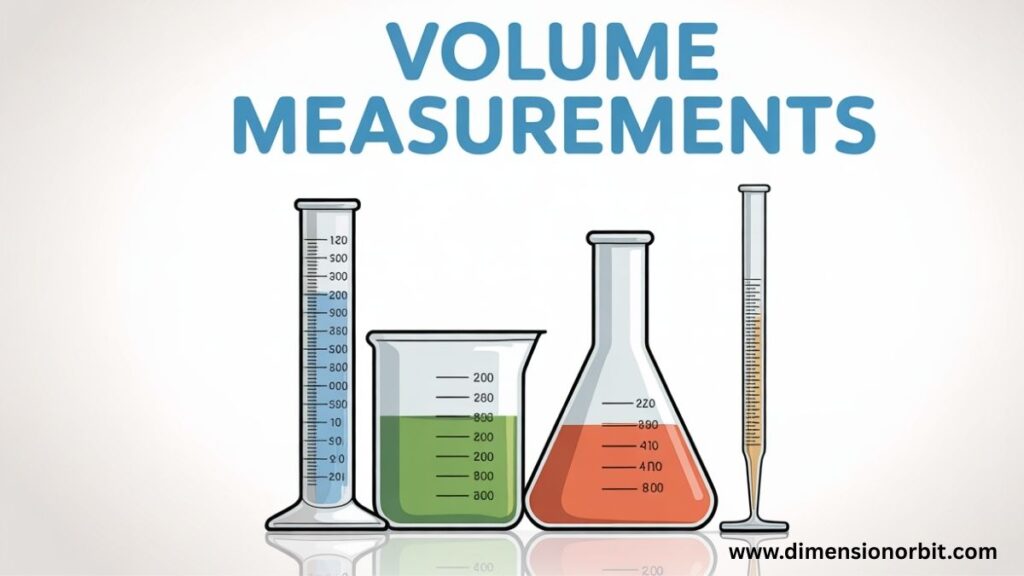
Volume measurements sounds boring until it ruins dinner. You follow a recipe, pour “about” a cup of milk, and suddenly your cake turns into soup. That small disaster explains why volume measurement matters more than people think. Volume decides how much space things occupy, how containers behave, and why guessing usually backfires. From cooking and medicine to fuel tanks and construction sites, volume runs the show. This guide breaks down what volume means, how volume measurement units work, and why simple math beats eyeballing every time. Expect clear explanations, real examples, and zero textbook yawns. By the end, volume won’t feel abstract. It’ll feel useful.
Universe Converter
Universe Converter
Length, weight, time, speed, data & more — all in one orbit.
Volume is one of those ideas everyone uses but few people truly understand. You pour water into a glass, fill fuel into a car, or measure milk for a recipe, and you assume the numbers make sense. Most of the time they do. Problems start when they don’t. That’s when volume measurement quietly turns into wasted money, ruined results, or even safety risks.
This article explains what volume is, how volume calculation really works, which volume units matter in daily life and professional settings, and why small misunderstandings create big errors. It’s written as a clear, human guide, not a textbook.
What Is Volume in Measurement?
At its core, volume is the measurement of three dimensional space. It tells you how much space an object occupies or how much space exists inside a container. That’s the entire idea. No shortcuts. No exceptions.
This is why volume in measurement always relies on three dimensions. Length alone cannot describe volume. Area cannot describe volume either. You need depth. Without it, you are not measuring volume at all.
In plain language, volume definition means the physical amount of space something takes up in the real world.
Why Volume Always Uses Cubic Units

People often ask why volume uses cubic units. The reason is logical, not arbitrary. When you measure length, or measure one direction. When you measure area, you combine two directions and you measure volume, you combine three.
That is why cubic units of volume exist. A cubic meter, for example, represents a space that is one meter long, one meter wide, and one meter high. Every valid volume unit either is cubic or comes directly from cubic space.
Liters, for instance, may look different, but one liter equals one cubic decimeter. The logic never breaks.
Volume vs Area: Why This Confusion Never Goes Away

One of the most common mistakes people make is mixing up volume vs area. This usually happens when containers are involved.
A large tray can have a big surface area while holding very little liquid. A narrow but deep container may have small surface area but large volume. When people judge by appearance, they often get it wrong.
Area describes surface coverage. Volume describes space inside. Once you separate those ideas, many everyday measurement problems disappear.
Volume vs Capacity Similar Words, Different Meanings
Another quiet source of confusion is volume vs capacity. These words sound interchangeable, but they are not.
Volume refers to the actual space occupied. Capacity refers to the maximum amount a container is designed to hold. In real life, usable volume is often slightly less than capacity due to safety margins, shape limitations, or air gaps.
This distinction matters in fuel storage, medicine, and industrial containers. Professionals never assume capacity equals usable volume. That assumption leads to spills, waste, and errors.
How Volume Calculation Works in the Real World

Volume calculation depends entirely on shape. Size alone tells you nothing without shape.
For regular shapes, formulas work reliably. A rectangular box uses length multiplied by width multiplied by height. Cylinders rely on circular area multiplied by height. Spheres require a different formula altogether.
What matters most is understanding that shape affects volume. Two containers that look similar can hold very different amounts. This is why visual estimation often fails and why formulas exist in the first place.
Metric Volume Units and Why the World Uses Them

The metric system dominates science, engineering, medicine, and global trade because it scales cleanly and logically. Metric volume units follow consistent base ten relationships, which makes conversion straightforward.
Liters serve as the most familiar metric unit in daily life. One liter equals one thousand milliliters and also equals one cubic decimeter. This direct relationship makes mental math easier and reduces error.
Milliliters matter when precision matters. In medicine, even small mistakes can be dangerous. That’s why milliliters in medicine remain the standard for dosage.
Cubic meters handle large scale measurements. Construction material volume, shipping space, and industrial planning all rely on cubic meters. One cubic meter equals one thousand liters, which keeps calculations predictable.
US Customary Volume Units and Their Practical Role

The US measurement system remains common in everyday use, especially in cooking and fuel measurement. US customary volume units include gallons, quarts, pints, and cups.
Gallons dominate fuel and water measurement. Quarts and pints appear in packaged goods and food storage. Cups remain popular in home cooking because they are convenient, even though they are less precise.
This system works well when used consistently. Problems arise when people mix it with metric units or assume conversions are exact when they are not.
Metric vs US Volume Comparison
Understanding the difference between systems prevents costly mistakes. The table below shows realistic comparisons used in practice.
| Metric Unit | US Equivalent (Approx) |
|---|---|
| 1 liter | 0.264 gallons |
| 1 gallon | 3.785 liters |
| 1 cubic meter | 264 gallons |
These numbers explain why mixing systems mid-calculation often produces errors. Professionals always convert first, calculate second, and convert back only if needed.
Volume Conversion Without Guesswork

A Volume conversion works because all units measure the same physical space. The safest approach is consistency. Convert everything into one unit system before calculating.
Estimation has its place. In cooking, rough equivalence works. In medicine, science, and construction, estimation is unacceptable. Knowing when precision matters separates casual use from professional measurement.
Volume Measurement in Real Life

The Volume shows up everywhere, often without people realizing it.
In cooking and baking, volume controls texture and flavor. Too much liquid ruins structure. Too little changes results entirely. That’s why experienced cooks rely on consistent volume measurement rather than guessing.
Fuel volume measurement affects cost, efficiency, and storage. Temperature changes cause liquid expansion, which is why fuel tanks include safety margins. Ignoring this leads to inaccurate readings.
Shipping and logistics rely on shipping volume calculation because space costs money. Packaging design directly affects profit. Efficient volume planning reduces waste and transport costs.
Construction depends heavily on volume. Concrete, soil, and gravel must be ordered by volume. Errors cause shortages, delays, or unnecessary expense.
Medical dosage volume leaves no margin for error. Precision saves lives. That is not an exaggeration. It is a fact of healthcare.
Common Volume Measurements Mistakes That Cost Real Money
Most volume errors come from assumptions. People assume containers are filled perfectly. They assume shape does not matter or assume capacity equals volume. They mix metric and US units without noticing.
Temperature effects on liquid volume get ignored frequently. Liquids expand when heated and contract when cooled. Professionals account for this. Casual users usually do not.
Each mistake seems small on its own. Together, they create serious problems.
How Volume Is Measured Accurately by Professionals
Professionals use tools, not guesses. Graduated containers provide reliable readings for liquids. The displacement method measures irregular solids by observing how much liquid they displace. This method directly measures occupied space and avoids shape assumptions.
Digital tools dominate industrial and laboratory settings. They reduce human error and provide consistent accuracy. Professionals choose tools based on required precision, not convenience.
Why Volume Still Matters in a Digital World
Even in a digital age, physical space does not disappear. Data centers manage airflow using volume. Packaging still occupies space. Logistics still charges by volume. Digital systems rely on physical infrastructure.
Understanding volume in science, engineering, and planning remains essential. Automation does not replace measurement. It depends on it.
Digital tool
Digital tools like Feet and Inches Calculator can convert inches to centimeters or feet instantly. Many smartphone apps now offer augmented reality measuring features, allowing you to gauge objects virtually and compare them to known lengths.
FAQs
What is volume in measurement?
Volume in measurement refers to the amount of three dimensional space an object occupies. It tells you how much space is inside or taken up, not how long or wide something looks.
Why does volume use cubic units?
Volume measurements uses cubic units because it measures space in three directions length, width, and height. Combining all three dimensions naturally creates cubic measurements.
What is the difference between volume and capacity?
Volume measures the actual space an object occupies, while capacity describes how much a container can hold. Capacity is a limit; volume is the real measured space.
How do you calculate volume accurately?
You calculate volume using formulas based on shape, such as length × width × height for boxes or specific formulas for cylinders and spheres. Shape always matters.
Which volume units are used most commonly?
The most common volume units are liters, milliliters, and cubic meters in the metric system, along with gallons, quarts, pints, and cups in the US system.
Why do volume conversions cause mistakes?
Mistakes happen when people mix metric and US units, round too early, or assume conversions are exact. Converting everything into one system first prevents errors.
How is volume measured for irregular objects?
Irregular objects are measured using the displacement method. You submerge the object in liquid and measure how much volume the liquid level changes.
Does temperature affect volume measurement?
Yes, temperature affects volume, especially for liquids. Liquids expand when heated and contract when cooled, which is why professionals account for temperature changes.
Why is volume important in real life?
Volume measurements matters in cooking, medicine, construction, shipping, fuel storage, and science. Accurate volume measurement saves money, improves safety, and prevents waste.
What is the best way to avoid volume measurements errors?
Use consistent units, rely on proper tools instead of guessing, account for shape and temperature, and double check calculations before acting on them.
Final Thoughts
Volume measurements isn’t just a school topic leftover you forget after exams. It shows up every time you cook, build, ship, store, or measure anything that takes up space. Once you understand volume measurements, the confusion fades. You stop guessing or stop mixing units. You start making decisions that actually work in the real world. Whether you’re dealing with liters in the kitchen, cubic meters on a job site, or milliliters in medicine, volume rewards clarity and consistency. Get the logic right, respect the units, and volume becomes a helpful tool instead of a silent troublemaker.

Jhon AJS, the author of Dimension Orbit, is an experienced blogger fascinated by the mysteries of existence. He explores every type of dimension from scientific to spiritual with clarity and creativity. Jhon’s engaging writing style invites readers to think deeper, question reality, and discover new perspectives on the universe.